

How to Draw Support and Resistance Levels Like A Pro - georgefounds
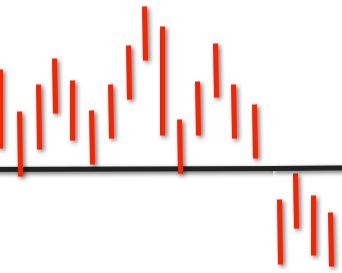 In my daily Forex comment each day, I guide in the key levels of support and ohmic resistanc that I feel are the most significant in the current market surroundings. It's something that I've through with for cheerio it really only takes me a couple of minutes to do now, it really is a very logical and simple task for me and IT can be for you too.
Many traders make the process of drawing off support and resistance levels a great deal Thomas More difficult than it needs to be. After you have a miscellaneous idea of how I draw my bear and impedance levels, you should have no trouble using that cognition as a rule of thumb to draw the levels yourself. We get tons of emails each week from traders asking how to decently draw support and resistance levels on their charts. Also, we get emails with graph attachments from traders who are clearly drawing far besides many levels on the charts, thus complicating the process of price action trading and perplexing themselves as well.
Now's lesson is loss to be a tutorial of how I draw up my levels in the market. Fundamentally, I'm going to take you guys on a ride through my wi (shivery I know) as I make up one's mind where to draw support and resistance levels on around real-clock time daily charts. You can use this lesson as a reference until you feel comfortable enough draught the levels connected your own. Also, it will help you to realize your own comment each day of your preferent markets; writing down your analysis rather than keeping it all in your head is a good way to stay on track and make a point you have a clear plan for the week and day ahead. To get started, let's clear up a few common myths about drawing support and impedance levels…
Common myths about draft support and resistor levels:
Myth 1: You should draw every raze you can find on your charts – Many traders fall for into this yap, they remnant up taking an hour to drawing card happening every little level they can find. What they fetch up with is a really untidy graph that fundamentally does more scathe than keen. You need to learn to haulage only if the significant levels on your charts, then you'll have a reusable theoretical account to work from.
Myth 2: Your S/R (support and resistance) levels should e'er be drawn crossways the exact highs OR lows of Mary Leontyne Pric bars – This is perhaps the biggest myth that traders make about drawing levels on their charts. Often times, support and resistance are more "zones" than exact "levels", sometimes you will have a key dismantle that is indeed an literal level, but more oftentimes than not we are going to be drawing our support and resistivity lines midway through bar tails or equal through the body of a bar sometimes. Point existence, you don't always give to draw the level exactly done the shrilling or low of the bar. Banker's bill: if you are totally bran-new and confused by some of the lingo hither, please take whatsoever time to get going over this candlestick tutorial before moving on.
Myth 3: You should get ahead back really far yet with your levels – Unless you are a farseeing-term buy-and-hold investor right now, you don't need to get back more than about 8 months when lottery your levels. If you view our free forex commentary you crapper interpret we really only focus on the final stage 3 to 6 months when drawing in the daily levels, and that goes for my personal personal trading as well. I am non sitting there trying to draw in levels from the last 5 years similar few traders…you are wasting away your time if you're doing this.
OK! Straightaway that we've cleared ascending those common myths more or less drawing S/R levels on your charts, let's move on to some "kernel":
How I draw support and opposition levels along my charts:
Downstairs are examples of how I would draw the relevant support and resistance levels on extraordinary of the stellar Forex pairs, Gold, Crude Oil and Dow Futures as they stand at the time of this writing. Higher up each chart is a brief explanation of why I drew the levels where I did.
Model 1: EURUSD Day-to-day CHART
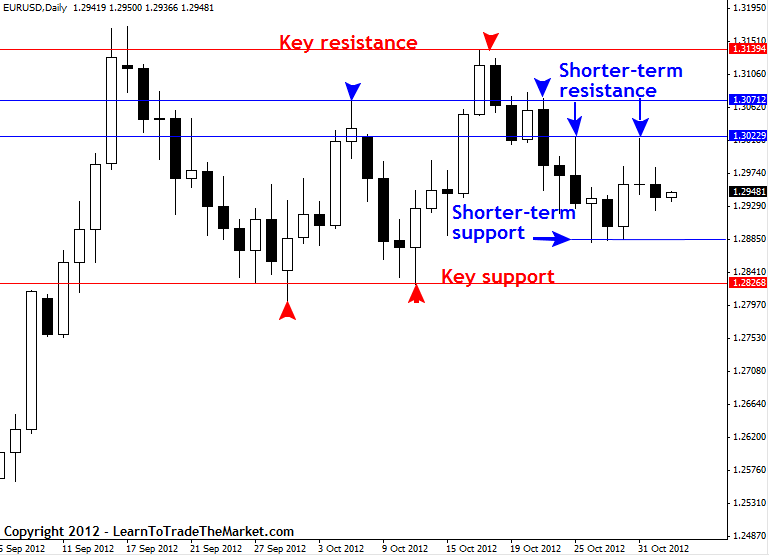
Present we are sounding at the current euro / dollar regular chart. You'll note the red lines highlight the longer-term Beaver State "key" levels and the blue lines highlight the shorter-term operating theatre "near-term" levels. This is how all the examples bequeath be in this lesson and hopefully IT will realize it easier for you to separate between what I much mention to A "key" levels from shorter-condition levels that aren't quite as significant.
In that lesson, you can see this marketplace is clear in a trading range right at once between about 1.3140-70 resistance and 1.2830 support. Those are what I would call the "key levels" on this current daily EURUSD graph. Inside the range, we have some shorter-term levels that are still significant albeit less so than the key levels just discussed. Of special note are the ii shorter-term resistance levels marked on the chart below. You testament see that the one come near 1.3070 is hitting a bar high from October 5thorium, but also it's going through the bodies and middle of the tails of the bars from October 17th – 23rd. This brings up a ample guide…a support or resistance grade can be profound even if IT isn't exactly moving bar highs and lows. This is also seen at the key resistance of the range, eminence how the line through 1.3140 is not affecting the exact highs on September 14th and 17th at 1.3171…this brings up the point that sometimes support operating room resistance is more of a "zone" than a strict / exact level. In this case the resistance of the current chain is really a small zone of resistance from 1.3140 to about 1.3171 (more on hold up / opposition "zones" presently).
Also of bill, in that location was an inside Browning automatic rifle on October 18th, and after the market broke down from that deep down bar it tried and true to rotate back upwards to about where it broke down at, and this breakdown level acted equally resistance and held the market off from advancing further, so as we potty see the market has since dead away from that level. These are whatsoever of the many subtle things you deman to learn about when drawing in your levels…especially shorter-terminus levels; that inside bar breakdown point held as a immunity, and often inside debar breakout points will act as support or resistance, equal if it's just for the short-run.
Example 2: GBPUSD DAILY CHART
Present's a good practice session for you to work on: When marker support and resistance levels on your charts, mark the longer-term "key" levels first and and then haulage the shorter-term levels. This volition work to pay you a fabric for the current market conditions and gives your analytic thinking some routine likewise.
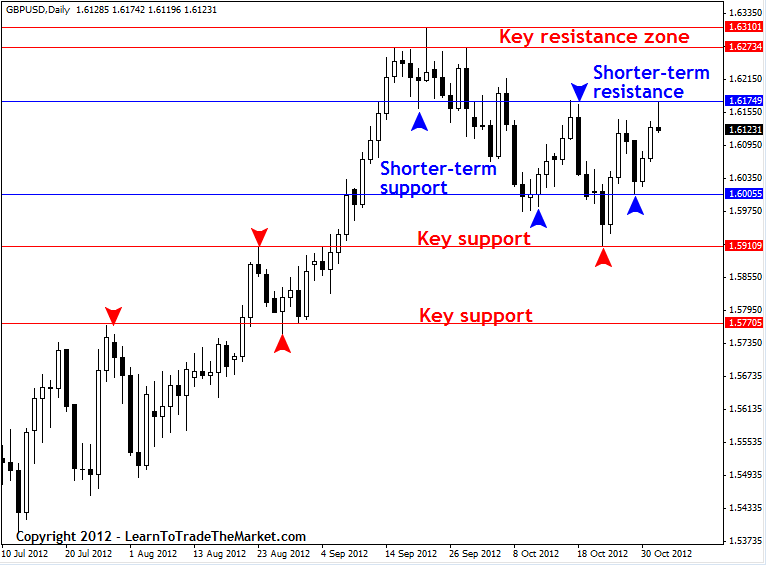
One of the things I often write about is support or resistance "zones", A often a support or resistance is not really an exact level but to a greater extent of a zone. In the good example below, we can watch a very good example of a resistance zone that occurs betwixt about 1.6270 and 1.6310.
"Key" support surgery resistance levels are generally levels that price rejected forcefully and that gave ascension to a significant incite up or push down, or they can be levels that bear contained or supported price many times. Whereas, shorter-term levels give hike to smaller movements and run to break easier. We can realize good examples of both in the GBPUSD daily chart below:
Example 3: AUDUSD Day-to-day Graph
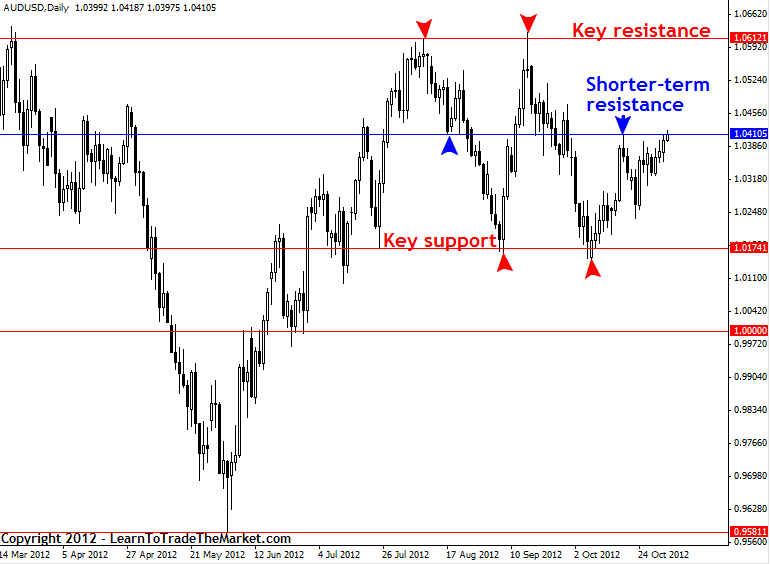
In this example we are looking at the AUDUSD every day chart and we can take in currently the market is in a mountainous trading range 'tween close to 1.0612 and 1.0175. We classify 1.0612 as "key resistance" since it has caused significant turning points in the market and held happening the last two tests. Similarly, 1.0175 is "key keep going" because it has led to significant turning points in the grocery and held on about the parthian 4 tests. The shorter-term level through 1.0410 is distinctly significant, but again it's non "quite" as significant equally the two levels just mentioned. As you can see, some of drawing in your levels and decisive which is more important than the other tail be left field up to your own interpretation, but at the same time you should have a logical line of reasoning such as "this level has held price more times", OR "that level created a larger displace", etc.
Example 4: USDJPY DAILY Graph
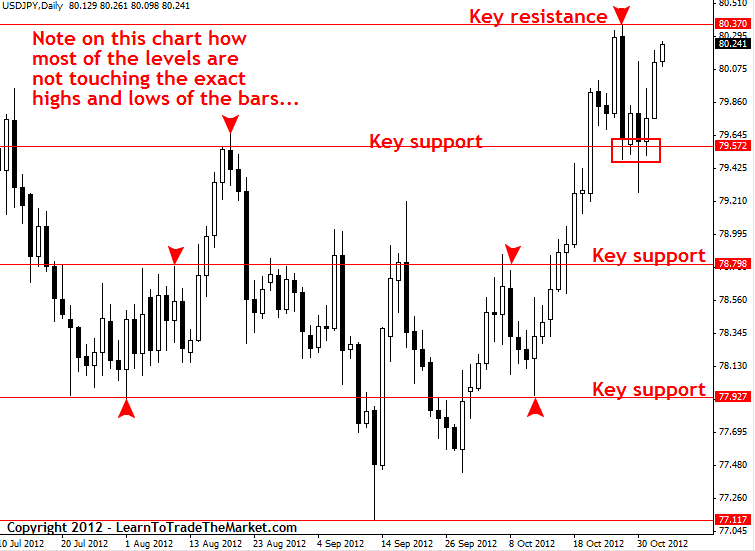
In the USDJPY example under, we are looking entirely "key levels" because I did not see any that I considered to be short-terminus levels. The reason being, every level I've drawn in has created a significant turn point. The USDJPY last has been breaking higher, and if the resistance near 80.37 gives way we will likely see another leg higher.
Of unscheduled preeminence in this chart are the bar tailcoat or wicks. Note how whatsoever of the levels are non worn just at the bar highs surgery lows merely sooner through the middle portion of the tail. This is important, and it's one of the myths I mentioned at the start of this lesson; you don't forever have to draw your S/R levels exactly at a taproo high or Low. In fact, it's many important to take over a lot of tails touching a level than it is to ingest a level exactly at ii or iii bar highs or lows. An example of this is the level at 78.79 in the chart to a lower place; bill how I drew it through and through as umteen bar tails (or wicks) that I could, rather than mobile it further up and just hitting the correct highs of a couple bars. Drawing your levels in that manner gives you a better reference point to seem for signals from since you are getting finisher to the mean or average turning bespeak price in the market, so it's basically a higher-probability level than a level that's further out but on the button at a block high or low. That's not to say you will never draw S/R levels at direct highs or lows, because you will, a lot, but information technology just means you don't always have to draw them that way and North Korean won't always want to.
Example 5: NZDUSD DAILY CHART
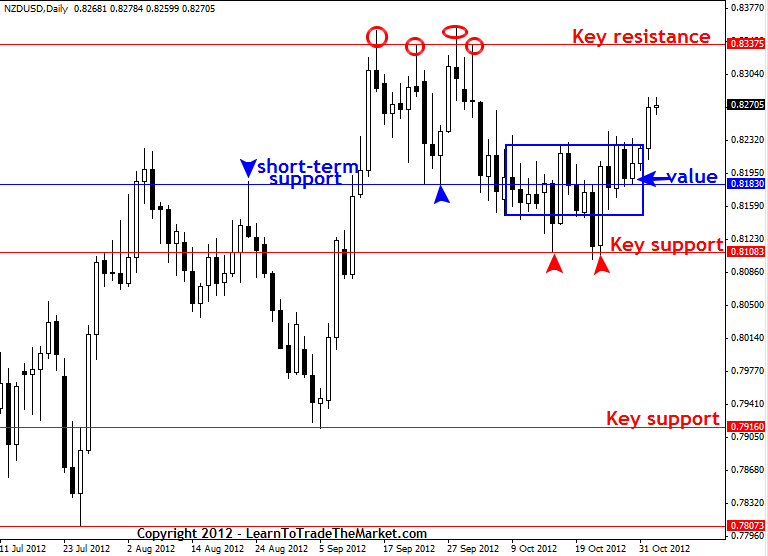
In the NZDUSD chart below we want to take note of what I refer to American Samoa a "value area". Now, what I mean by "value area" is basically just an area where it's writ large that price "likes" to be. This is essentially just another discussion for integration, since an area of consolidation on a graph is in essence where a market has found "fair value". These value areas typically act as support or opposition zones, and this means when price retraces back to them you fundament watch for price action trading strategies forming at them. You will also sometimes own existing support or opposition levels that essentially run right through the essence of a value area, showing about the middle of the treasure area, and we can see this distinctly past the down in the mouth line in the chart below. In this specific NZDUSD example that depressed value line of credit would be a nifty support to watch for buy signals if price rotates lower soon.
Lesson 6: USDCAD DAILY CHART
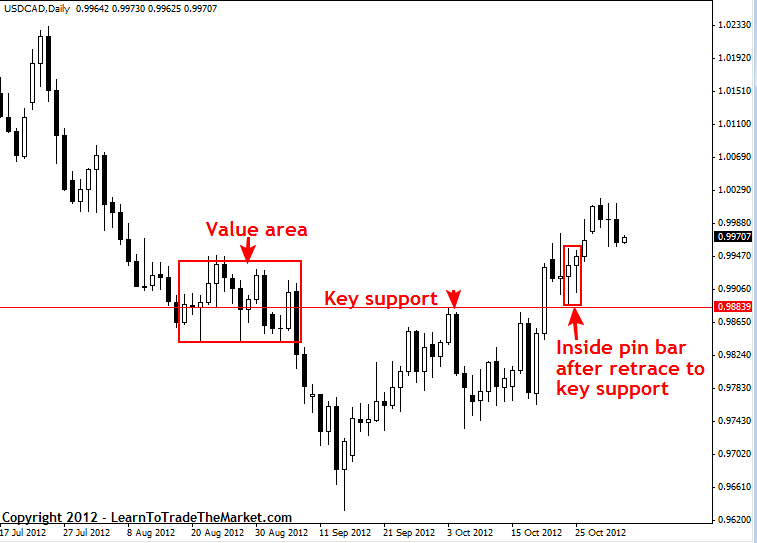
The USDCAD daily graph below shows us a good example of the "value" conception that I discussed in the last example. Note how price botuliform that area of consolidation or "apprais" marked happening the chart below, and then after price retraced back up to it and base resistance exactly at the center of the value near 0.9883 on October 3rd. Then, aft toll finally broke back above that value level it formed a price action setup after IT retraced back down to that, as we crapper see an inside pin bar combo setup formed display rejection of that same level.
So, here's a very ensiform strategy for you; wait for a key level to break, then wait for price to retrace back to information technology and look to a price action mechanism setup ingress trigger to form near the breakout level in the direction of the initial breakout.
Example 7: EURJPY Each day CHART
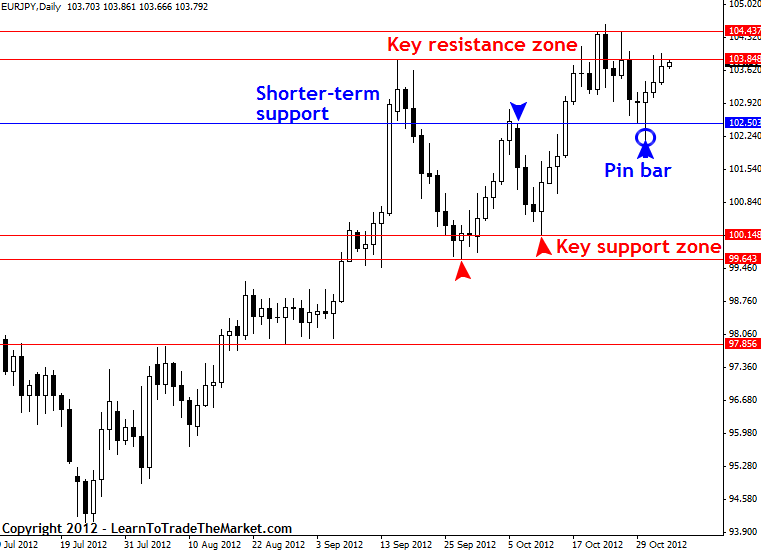
We can undergo in the EURJPY chart at a lower place that it's been in an uptrend since about the end of July. This uptrend has had both bad large counter-sheer retraces, which of course we need to mark with levels. We can insure in the graph beneath the support levels and zones left behind aside the different points in the securities industry were the retrace terminated and the uptrend resumed. Too, in a trending market like this, we terminate watch the former swing points for price action signals as the market retraces back to them. For example, in an uptrend we can looking for Mary Leontyne Pric action entries at the previous resistance / swing points in the market which turn into supporting later on price breaks upwards past them. We can see a clear lesson of this in the graph below with the recent pin bar trading strategy that s-shaped at the shorter-term support through 102.50 area, note that this level was previous resistance.
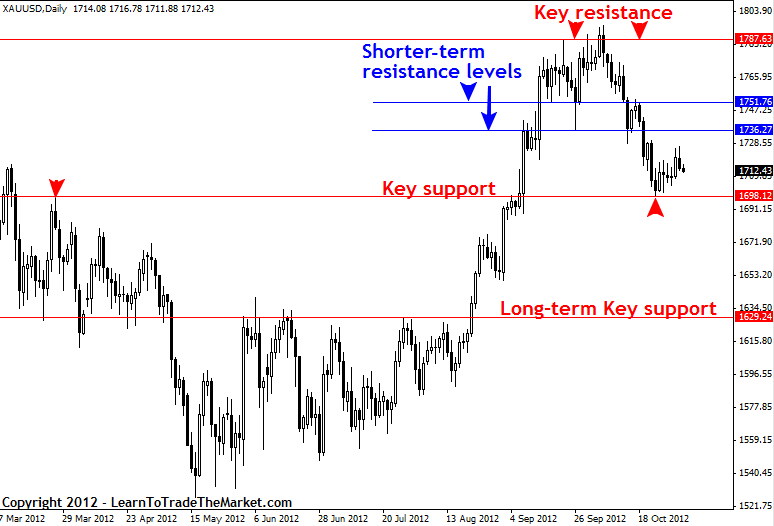
Model 8: XAUUSD Day-after-day CHART
In the Gold chart below, you can see I've gone back about 8 months in drawing in my long-terminus levels. This is about the farthest back I typically spell when drawing in my levels along the each day charts. Again, longer-term "key levels" are those levels that clearly caused a significant change of direction in price and / or held strong on quadruplicate tests across time. Shorter-term levels are those that caused less large price direction changes and English hawthorn be "newer" levels. You don't have to get carried away draft in to a fault many of the shorter-term levels though, evenhanded use common sense and decide which are the most transparent and draw those in. If you put too numerous support and resistance levels on your charts you'll end up with a untidy chart that just confuses you and might even cause you not to trade because you think in that location are too many another levels for the market to consume to move through.
This brings me to a very important point you should remember: In an up-trending market, impedance levels will often fracture, and in a shoot down-trending grocery store keep going levels will often break. I say that because I get a lot of emails from traders telling ME they can't get a proper 1:2 operating room more risk reward ratio because in that location are too many a support or resistance levels in the way. Cured, you have to looking at at the commercialise context that your swop setup has formed in and use or s common sense and discretion…not every little level you find is significant.
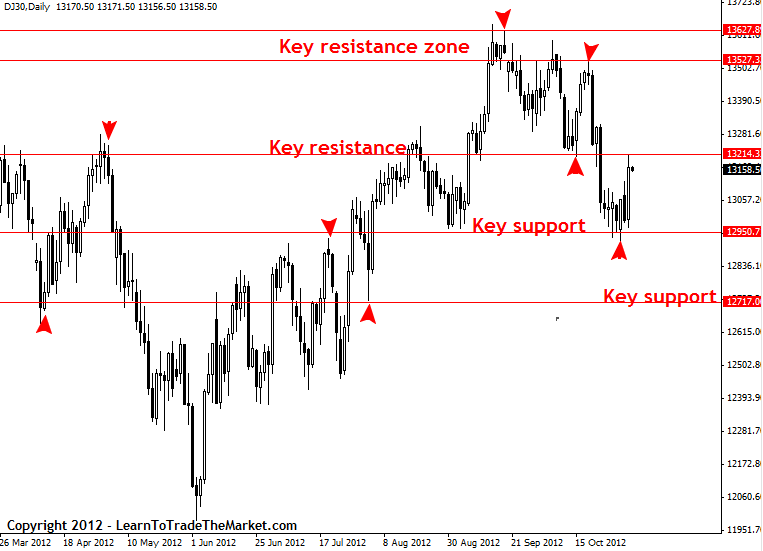
Lesson 9: DJ30 Unit of time CHART
In the Dow John Luther Jone futures graph below, we hindquarters see the current envision of winder levels that are relevant for this market. Of special note, we can see how systematically these key levels reserve as price retraces back to them. Knowing that price often bounces Oregon repels from key levels is a very valuable piece of info. Indeed, a mountainous portion of my trading theory revolves around waiting patiently for an open cost action setup to form at a key chart level as the securities industry retraces stake to it. If you observe this chart for a a couple of minutes, you'll begin to see how accurate these levels are in rejecting, it really is weird.
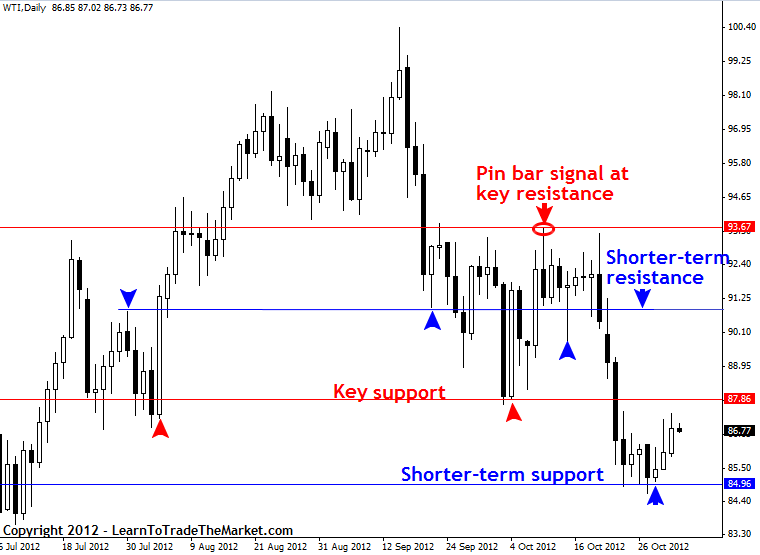
Example 10: WTI DAILY CHART
In the example below, we are looking at the current Crude Oil chart. This chart shows us a very important lesson. Musical note the tholepin block u marked on the chart at a lower place, IT was an obvious pin bar that showed forceful rejection of a key resistance level, and then the market cut about about 6 days in front finally whirling lower. The most obvious stay loss placement on that pin bar would have been rightful above its high which was also the fundamental resistance finished $93.65 area. If you enter an obvious price action setup like that and you've placed your stop loss at a logical speckle in-line with the existing market body structure, there's no reason to panic if the market moves against you and almost stops you out. This exact scenario was very likely in this Fossil oil inunct thole banish setup, and I know some traders who panicked when price moved against them. Had they meet stayed in the market, their initial stops fitting above the key resistivity would non take over been bang and they would have made a killing. Lesson: corporate trust your Newmarket if you've placed them on the far side a key support Oregon resistance level or in another logical place.
Conclusion:
I Bob Hope you now have a advisable estimation of how I pull back support and resistance levels happening my charts and wherefore I draw them where I do. I suggest you try drawing off the relevant levels on your charts now accordant to what you've noninheritable in today's lesson. Also, observe my day by day Forex comment for a good daily instance of how I draw the levels on a major grocery store to each one 24-hour interval.
Determining where to draw your support and resistor levels is really not as difficult as many traders get in proscribed to personify. When in doubt, slow downbound and take a step back, enquire yourself if a level your about to put on your chart makes sense and wherefore. If it makes legitimate sensory faculty you should be capable to easy explicate why to someone who has no trading experience. For example, you might tell "This level is measurable because it clearly caused price to make a significant change of direction recently". If you vindicatory drive a logical approach to drawing in your support and resistivity levels you will save yourself a slew of time and defeat in the end. Don't beryllium same of those traders with so many lines on their charts you privy't figure out what's happening. If you would wish more help oneself with drawing support and resistance levels you bet to utilization them in combining with damage action strategies, check-out procedure my Forex price action trading course for more in-depth instruction.



Source: https://www.learntotradethemarket.com/forex-trading-strategies/how-to-draw-support-and-resistance-levels
Posted by: georgefounds.blogspot.com
0 Response to "How to Draw Support and Resistance Levels Like A Pro - georgefounds"
Post a Comment